
Anomalomyces panici Vánky, R.G. Shivas & M. Lutz
| Description |
Sori in some ovaries of an inflorescence,
globose or ovoid, 2.0–3.5 mm long, 1.5–3.0 mm wide, covered by a thick
peridium of host and fungal origin, initially green, becoming brown, at
maturity rupturing irregularly at the apex, exposing the dark brown
semi-agglutinated to granular-powdery mass of spore balls mixed with
numerous sterile cells.
Spore initials agglomerated in the hyaline
mass of sporogenous hyphae, elongate, each with a rounded top,
increasing in size, becoming globose, 4–5 µm diam.
Immature spore balls delimited by a
2.0–2.5 µm thick oliveaceous brown continuous layer formed from the
thickened external wall of the outermost spores. By maturity, spores
increasing in size, becoming pigmented and polyangular by mutual
pressure; hyaline fungal mass around the spores and the spore balls
gradually consumed, leaving fungal cells from which sterile cells
develop.
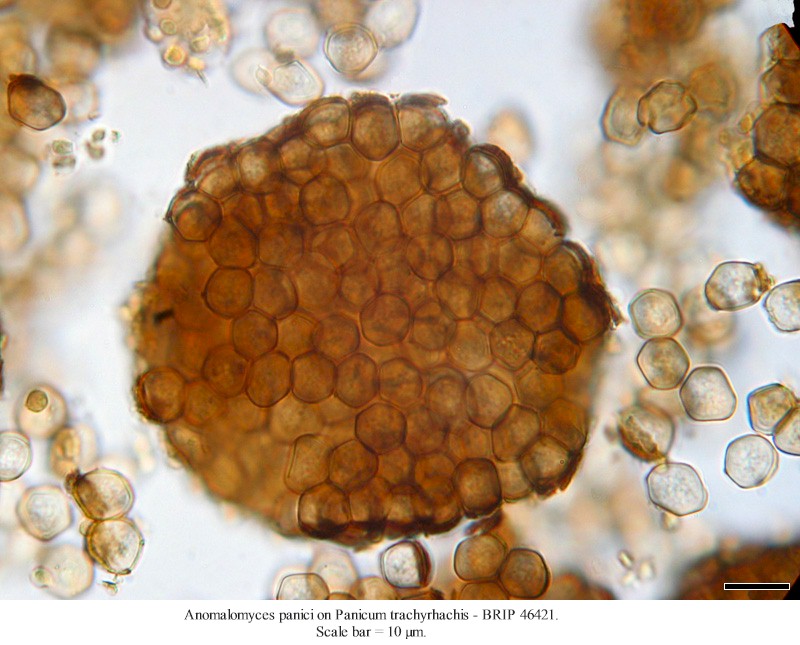
Spore balls subglobose, ovoid, ellipsoidal
to subpolyhedrally irregular, 30–200 × 25–120 µm, dark olivaceous brown
or opaque, permanent, composed of tens to hundreds of tightly packed
spores that separate by hard pressure.
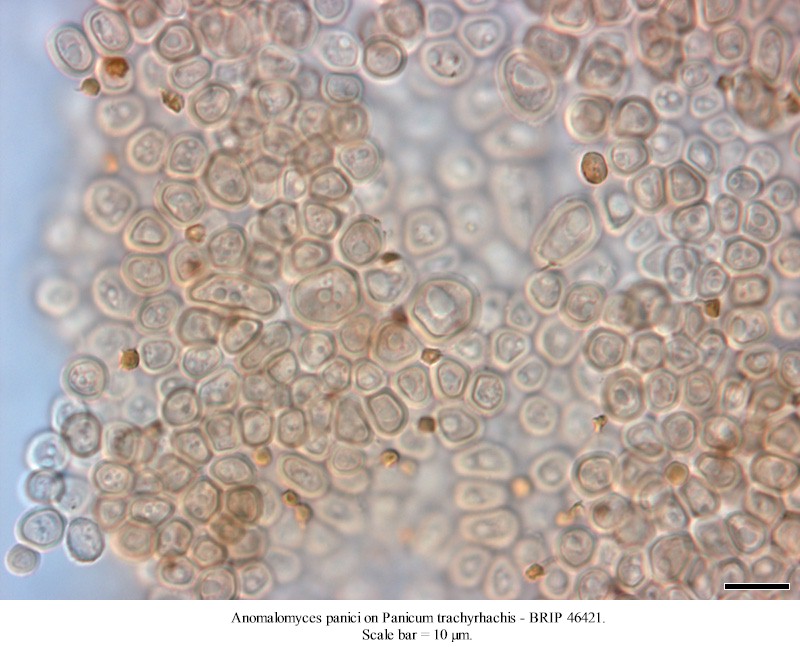
Spores rounded, subpolyhedrally or
polyhedrally irregular, 8–11 (–12) × 8.0–10.5 µm, pale olivaceous brown;
wall uniformly c. 0.5 µm thick, smooth except for the free surface of
the outermost spores in the balls which is 1.0–2.5 µm thick, dark
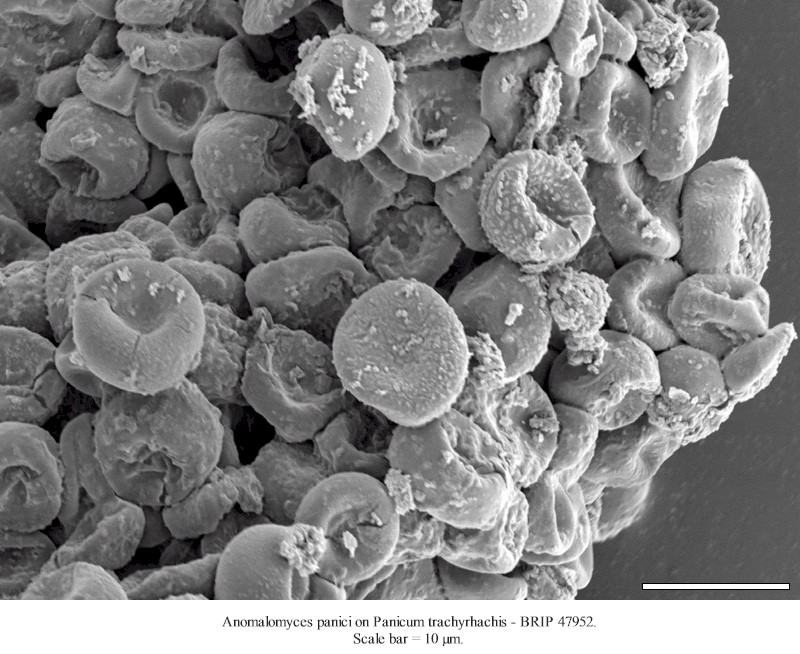
olivaceous brown, apparently smooth to very finely punctate-verruculose;
in SEM 2–several rounded low warts often fusing and forming an irregular
pattern.
Spore germination (on slide, in humid
chamber, at room temperature, in 1 day) resulting in 4–6-celled
phragmobasidia 30–60 × 2.5 µm. Basidiospores numerous, fusiform,
produced laterally and terminally on sterigmata on the basidia, 8–13 ×
0.8–1.5 µm, giving rise by germination to a chain of successively
smaller fusiform sporidia.
Sterile cells between the spore balls
solitary, of 2 distinct types. Larger sterile cells globose, subglobose,
ovoid, ellipsoidal or slightly irregular, 8–15 × 7–12 µm, pale
olivaceous brown; wall of 2 layers, even or slightly unevenly 1.2–2.5 µm
thick, smooth. Smaller sterile cells globose, subglobose, ovoid or
rounded subpolyhedrally irregular, often with 1 or 2 subacute tips, then
tear-shaped or lemon-shaped, 3.0–5.5 × 2.5–5.0 µm, medium to dark
olivaceous brown; wall thin (c. 0.2–0.3 µm), smooth, often with a short
narrow hyphal appendage to 5 µm long.
| Hosts | |
| Host family: | Poaceace |
| Host species: | Panicum trachyrhachis Benth. |
| Distribution |
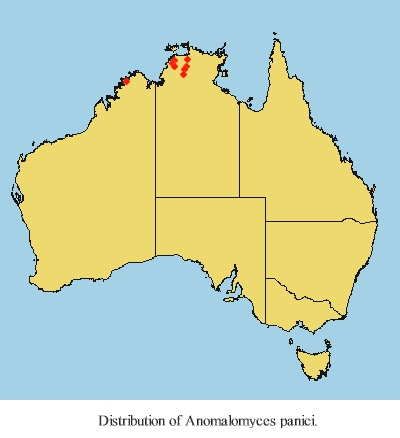
States & Territories: NT, WA